If seeing the Northern Lights is at the top of your Lapland bucket list, you're probably wondering whether you need to book an expensive aurora tour or if it's possible to see them for free.
The good news is that you absolutely can see the Northern Lights without paying for a tour.
We've now visited Finnish Lapland three times and have been lucky enough to see the aurora on more than one occasion. The first time was during an unforgettable evening at Polarman's Camp in Levi, where we spent the night learning about the science and folklore behind the aurora before watching the lights dance across the sky.
Since then, we've also seen them completely free while standing beside the frozen lake near K5 Hotel in Levi, and again after an evening at the Arctic SnowHotel following dinner in the Ice Restaurant.
Those experiences taught us something important.
You don't need to book a Northern Lights tour to see the aurora. If the conditions are right, everyone underneath the same clear sky has exactly the same chance of seeing them.
What a tour gives you is the overall experience. Depending on the operator, that might include transport to darker skies, local guides who monitor the forecast throughout the evening, warm shelters, campfires, hot drinks and even the flexibility to drive to areas with clearer skies if cloud rolls in.
Some operators will travel considerable distances, sometimes even crossing into Sweden or Norway, in search of better conditions.
We've experienced both sides ourselves. We've seen the Northern Lights completely free while staying in Levi and again during an evening at the Arctic SnowHotel in Rovaniemi. We've also seen our very first display during a guided tour at Polarman's Camp.
On another trip, we joined a Northern Lights snowmobile safari but never saw the aurora because thick cloud rolled in. Even so, riding snowmobiles through the Arctic forests after dark was still one of the highlights of the holiday.
In this guide, I'll explain everything we've learnt after three DIY trips to Lapland, including the best time to visit, the places where we've seen the Northern Lights ourselves, the apps we use to track them, and whether I think paying for an organised aurora tour is actually worth it.
From DIY itineraries and Northern Lights tips to budgeting advice, destination guides and honest reviews of the places we've visited, you'll find everything together in our Lapland Travel Guide Hub.
Just a quick note before we begin. Some of the links in this guide are affiliate links. This means we may earn a small commission if you make a purchase through them, at no extra cost to you. We only recommend products, services and experiences we've used ourselves or genuinely believe will help you plan your trip. Thanks for supporting Build a Break.
🌌 Can you see the Northern Lights for free? Yes. If conditions are right, you don't need to book an organised tour.
📅 Best time to visit: Late September to late March, with December to February offering the longest dark nights.
📍 Best places we've seen them: Polarman's Camp in Levi, the frozen lake by K5 Hotel in Levi, and outside the Arctic SnowHotel near Rovaniemi.
⏳ Recommended stay: At least 4–5 nights to give yourself multiple chances if the weather doesn't cooperate.
☁️ Biggest factor: Clear skies. Cloud cover is often a bigger obstacle than low aurora activity.
📱 Best apps: My Aurora Forecast, Aurora Alerts and Windy to check cloud cover.
🚗 Do you need a tour? No. We've seen the Northern Lights both on an organised excursion and completely independently.
💰 Are Northern Lights tours worth it? Yes, but for the overall experience, not because they can guarantee you'll see the aurora.
💡 Top tip: Don't wait until 10pm to start checking. We kept an eye on the forecast throughout the day and were always ready to head outside as soon as conditions looked promising.
💸 Top tip: Book a northern lights tour through GetYourGuide and use our exclusive code BUILDABREAK5 in the app to save 5% on eligible bookings.
Yes, and we've done exactly that.
Although the first time we saw the Northern Lights was during an organised evening at Polarman's Camp in Levi, we've since watched them completely free on two separate occasions: once beside the frozen lake near K5 Hotel in Levi, and again after an evening at the Arctic SnowHotel following dinner in the Ice Restaurant.

One of the biggest misconceptions is that you need to pay for an organised excursion to see the aurora. In reality, if the conditions are right, everyone standing beneath the same clear sky has the same chance of seeing them. A guide can't make the Northern Lights appear, and even the most expensive tour can't guarantee a sighting if thick cloud rolls in.
That said, many Northern Lights operators do have one big advantage over independent travellers. Rather than staying in one location, they'll monitor the weather and, if necessary, drive long distances in search of clearer skies.
On some evenings that might simply mean moving to another part of Finnish Lapland, while on others they may even cross the border into Sweden if the forecast looks more promising there. Some companies also offer a free second tour or discounted rebooking if conditions mean you don't see the aurora, although the policy varies between operators, so it's always worth checking before you book.
That's not to say tours are essential. If your only goal is to see the Northern Lights, you don't have to book a tour. If you're looking for a memorable Arctic evening with local guides, food, campfires and stories, then a Northern Lights tour can absolutely be worth it.
If you're planning a trip to Lapland, you'll probably want to know one thing above all else: what are the chances of actually seeing the Northern Lights?
The honest answer is that nobody can guarantee it.
The aurora is a natural phenomenon, so whether you see it depends on a combination of solar activity, cloud cover and a little bit of luck. Even if the Northern Lights are active above Lapland, thick cloud can completely hide them from view.
The good news is that Finnish Lapland is one of the best places in Europe to see the aurora. Thanks to its far northern location, long winter nights and very low levels of light pollution, you have an excellent chance of seeing the Northern Lights if you visit between September and March.
One of the biggest things we've learnt after three DIY trips is that the length of your stay often matters more than anything else.

If you're only visiting for one or two nights, you're relying on everything lining up perfectly. Stay for four or five nights, however, and you give yourself several opportunities if one evening is cloudy or aurora activity is low.
That's exactly why we'd recommend spending at least 4–5 days in Lapland if seeing the Northern Lights is one of your main priorities.
💡 Top tip: Don't obsess over the aurora every evening. Enjoy the other incredible experiences Lapland has to offer, keep an eye on the forecast throughout your trip and be ready to head outside whenever conditions look promising. That's exactly how we've ended up seeing the Northern Lights on more than one occasion.
The Northern Lights season in Finnish Lapland usually runs from late September until the end of March, when the nights are dark enough for the aurora to be visible.
That doesn't mean you'll see them every night. Even during peak season, sightings depend on a combination of solar activity, clear skies and a little luck. After three trips to Lapland, we've found that cloud cover is often far more important than the aurora forecast itself. A spectacular display above the clouds is no help if you can't see the sky.
If your main goal is to see the Northern Lights, here's what you can generally expect throughout the season:
The season begins as the nights become darker. Snow isn't guaranteed early in autumn, but you'll often find fewer visitors, milder temperatures and excellent opportunities to see the aurora.
This is the classic Lapland season. You'll usually find deep snow, magical winter scenery and the longest nights of the year, giving you plenty of opportunities to look for the Northern Lights. It's also the busiest and most expensive time to visit, particularly around Christmas and the February half term.
March is one of my favourite times to recommend. There's still usually plenty of snow, but you'll also enjoy longer daylight hours for activities such as husky sledding, snowmobiling and skiing before heading out in the evening to look for the aurora.
For most people, I'd recommend visiting between January and March if seeing the Northern Lights is one of your main priorities. You'll normally have reliable snow cover, plenty of darkness and fantastic conditions for enjoying everything else Lapland has to offer.
💡 Top tip: Rather than worrying about choosing the perfect month, focus on staying for at least four or five nights. That gives you several opportunities if one evening is cloudy or the aurora isn't particularly active.
One of the biggest myths about the Northern Lights is that every destination in Lapland offers the same chance of seeing them.
That's not quite true.
While you can potentially see the aurora anywhere in Finnish Lapland under clear skies, your chances do vary depending on how far north you are, how much light pollution there is and how many dark nights the destination experiences each year.
If seeing the Northern Lights is your number one priority, I'd choose one of Lapland's more northerly destinations, such as Saariselkä, Ivalo or Inari. They generally experience more aurora nights each year than destinations further south, such as Rovaniemi, and their darker skies can make displays even more spectacular.
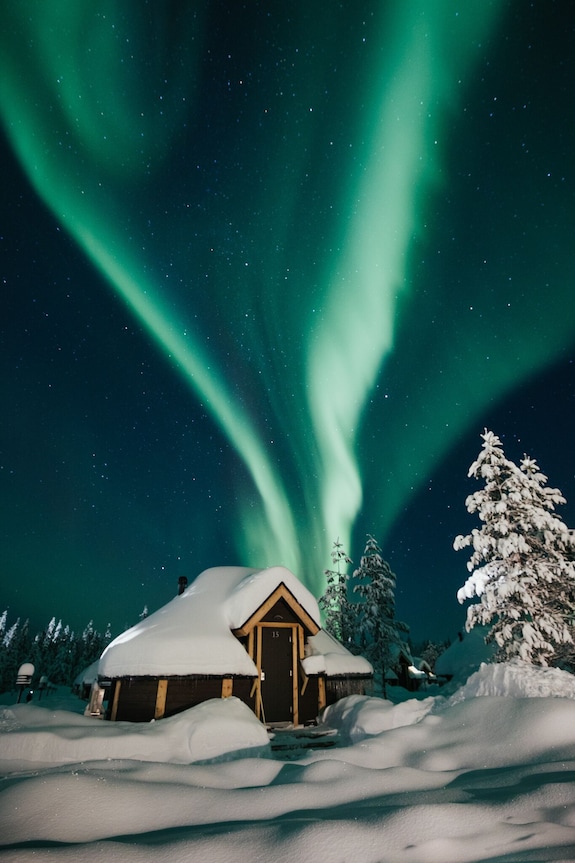
That doesn't mean you shouldn't choose Rovaniemi or Levi. Both still offer excellent opportunities to see the Northern Lights and combine that with easier access, more activities and, in Rovaniemi's case, Santa Claus Village. It's simply about deciding what matters most for your trip.
Here's how I'd compare the main destinations.
If your main reason for visiting Lapland is to maximise your chances of seeing the Northern Lights, Saariselkä would be one of my first recommendations.
Located much further north than Rovaniemi, Saariselkä experiences around 200 potential aurora nights each year and has very little light pollution. Combined with its location beside Urho Kekkonen National Park, it offers some of the darkest skies you'll find in Finnish Lapland.
It's also one of the best places to stay if sleeping in a glass igloo is on your bucket list, with several of Finland's most famous aurora resorts based here.
I'd choose Saariselkä if seeing the Northern Lights is your number one priority and you're happy to swap Santa attractions for quieter surroundings and a more traditional Arctic experience.
Levi strikes what I think is the best balance between excellent Northern Lights opportunities and having plenty to do during the day.
We've now seen the aurora here twice. The first time was during an unforgettable evening at Polarman's Camp, and the second was completely free beside the frozen lake near K5 Hotel. One of the things I like most about Levi is that it's easy to leave the village lights behind without travelling very far.
While destinations such as Saariselkä and Ivalo have slightly better aurora statistics, Levi still gives you an excellent chance of seeing the Northern Lights while offering one of Lapland's best selections of activities, restaurants and accommodation.
I'd choose Levi if you want an all-round Lapland holiday rather than a trip focused solely on chasing the aurora.
Rovaniemi is probably the most famous destination in Finnish Lapland, but if your only goal is seeing the Northern Lights, it wouldn't be my first choice.
That's simply because it's further south than destinations such as Saariselkä, Ivalo and even Levi. It's also a city rather than a small village, so there's naturally more light pollution around the centre. That doesn't mean you can't see the aurora though. We've been lucky enough to see the Northern Lights here ourselves after an evening at the Arctic SnowHotel and Ice Restaurant, proving you certainly don't have to travel to the far north to experience them.
One advantage of Rovaniemi is that it's incredibly easy to combine Northern Lights hunting with everything else Lapland has to offer. During the day you can visit Santa Claus Village, go husky sledding, snowmobiling or reindeer riding, then head away from the city lights in the evening to look for the aurora. Places such as the Arctic SnowHotel, Ounasvaara and quieter areas along the river all offer much darker skies than the city centre.
I'd choose Rovaniemi if you were visiting Lapland for the first time and wanted a holiday that balanced Santa experiences, winter activities and the chance of seeing the Northern Lights. If, however, the aurora was your main reason for travelling, I'd probably head further north.
If your main aim is to maximise your chances of seeing the Northern Lights, Ivalo and nearby Inari are two of the best places you can choose.
Located even further north than Rovaniemi and Levi, this part of Finnish Lapland experiences around 200 potential aurora nights each year. The area is also incredibly sparsely populated, meaning there's very little light pollution to compete with the night sky.
One of the biggest attractions here is Lake Inari, Finland's third-largest lake. During winter, its vast frozen surface creates huge open spaces with uninterrupted views of the sky, making it a fantastic place to watch for the aurora. It's also home to several luxury wilderness lodges and glass igloo resorts, many of which are designed specifically with Northern Lights viewing in mind.
Compared with destinations such as Levi or Rovaniemi, you'll find fewer attractions and a much quieter atmosphere. That's part of the appeal. If your idea of the perfect Lapland holiday is spending your evenings searching for the aurora and your days exploring snowy forests, frozen lakes and the Arctic wilderness, Ivalo and Inari are hard to beat.
I'd choose Ivalo or Inari if seeing the Northern Lights was my absolute priority and I wanted a peaceful escape surrounded by nature.
If your main reason for visiting Lapland is to maximise your chances of seeing the Northern Lights, Ylläs is one of the best places you can choose.
The area sits well north of the Arctic Circle and is made up of the villages of Äkäslompolo and Ylläsjärvi, surrounded by forests, frozen lakes and the vast Pallas-Yllästunturi National Park. With almost no light pollution outside the villages, you don't usually have to travel far to find excellent viewing conditions.
One of the biggest advantages of Ylläs is how quiet it feels. Compared with Rovaniemi and even Levi, there are far fewer visitors, meaning it's easy to find peaceful spots where you're standing beneath a huge open sky with very little artificial light.
Many visitors simply walk onto a frozen lake or head a short distance along one of the forest trails on a clear evening. If the aurora is active, there are very few places in Finnish Lapland that offer a more dramatic backdrop.
Ylläs is also an excellent destination if you're combining Northern Lights hunting with skiing, snowshoeing or cross-country skiing, making it a great choice for travellers who want a more nature-focused Lapland holiday.
Although we haven't visited Ylläs ourselves yet, it's consistently rated as one of Finland's top destinations for aurora viewing thanks to its northern location, dark skies and low levels of light pollution.
Pyhä-Luosto is one of Lapland's hidden gems for Northern Lights hunting and a fantastic choice if you're looking for somewhere quieter than Rovaniemi or Levi.
Located around 90 minutes north of Rovaniemi, the area combines two small ski resorts with Pyhä-Luosto National Park, Finland's oldest national park. The lack of major towns nearby means there's very little light pollution, giving you excellent conditions for spotting the aurora on clear nights.
The national park is particularly good because it offers wide, open viewpoints away from artificial lighting. Many visitors simply head to one of the park's trails or frozen open areas after dark rather than booking an organised excursion.
Pyhä-Luosto also has a more relaxed atmosphere than some of Lapland's larger resorts. If your main priority is spending time in nature, enjoying winter activities during the day and watching for the Northern Lights in the evening, it's an excellent option.
Although we haven't visited Pyhä-Luosto ourselves yet, it's a destination that's consistently recommended by aurora photographers and repeat visitors because of its dark skies, peaceful surroundings and reliable winter conditions.
If your only priority is maximising your chances of seeing the Northern Lights, I'd rank the destinations like this:
That doesn't mean you won't see the Northern Lights in Rovaniemi.

The reality is that clear skies matter far more than choosing between these destinations. I'd much rather spend four or five nights in Rovaniemi than two nights in Saariselkä. Giving yourself more opportunities almost always has a bigger impact than moving a little further north.
Seeing the Northern Lights isn't just about choosing the right destination. Once you're in Lapland, there are a few things you can do that will dramatically improve your chances.
This is probably the biggest piece of advice I can give.
Many people book a two-night trip expecting to see the aurora, but unfortunately it doesn't work like that. Even if the Northern Lights are active, cloud cover can completely hide them.
We've now visited Lapland three times. On one trip we saw them on our very first evening, while on another we had to wait until much later in the holiday. That's completely normal.
The longer you stay, the more opportunities you'll have if conditions improve.
Even in Lapland, street lighting can make weaker auroras much harder to see.
You don't usually need to travel miles into the wilderness. Simply walking to a frozen lake, a riverside or the edge of the village is often enough.
Some of our favourite free viewing spots include:
• K5 Hotel and the frozen lake in Levi
• The Arctic SnowHotel area outside Rovaniemi
• Quiet roads and open spaces away from Levi village centre
Cloud is the biggest enemy of Northern Lights hunters.
You could have a strong aurora directly above you and never know it if thick cloud covers the sky.
Before wrapping up and heading outside, always check both the aurora forecast and the cloud forecast. Sometimes driving just 30 or 40 minutes can make the difference between a completely cloudy sky and a spectacular display.
This catches lots of first-time visitors out.
The Northern Lights don't always explode across the sky like they do in Instagram photos.
Sometimes they appear as a faint white glow for 20 or 30 minutes before suddenly becoming brighter and starting to dance overhead.
If conditions look promising, don't head back inside after ten minutes. Give yourself time.
One trick we've started using is checking the live webcams before wrapping up and heading outside.
Several Lapland destinations have webcams overlooking the sky, including Levi, where you can often see whether the skies are clear before leaving your accommodation. They're also useful for checking if cloud is starting to roll in or if conditions look promising.
They won't always show weaker auroras, but they can save you from standing outside for an hour under completely overcast skies.
We also like checking the webcams before bed. If the sky is crystal clear, we'll often keep one eye on our aurora app and be ready to head outside if activity suddenly increases.
💡 Top tip: If you're staying somewhere with a clear view of the sky, keep your curtains open and check the forecast throughout the evening. The Northern Lights can appear at any point during the night, so it's worth staying flexible rather than assuming you've missed them.
One of the biggest myths about seeing the Northern Lights is that you need to rely on luck. While there's never any guarantee, a few free apps can significantly improve your chances by showing aurora activity, cloud cover and local forecasts.
Before every trip to Lapland, and even when we're at home in the UK hoping for a rare display, I use the same two free apps. They're simple to use and have become an essential part of planning our evenings whenever we're chasing the aurora.
This is the app I use the most and the one I'd recommend downloading first.
It combines aurora forecasts, the KP index, cloud cover and local weather into one easy-to-understand app. You can also turn on notifications, so you'll receive an alert if aurora activity suddenly increases while you're relaxing back at your accommodation.
I've used My Aurora Forecast in Finland, Iceland and even here in the UK, and it's become the first app I check whenever there's a chance of seeing the Northern Lights.
The second app I always have installed is Aurora Alerts.
It works slightly differently by sending notifications when there's increased aurora activity in your chosen location. I like using it alongside My Aurora Forecast rather than relying on just one app.
Again, it's one I've used across multiple trips to Finland and Iceland, as well as during the rare occasions when the Northern Lights have been visible from the UK.

One thing that often confuses first-time visitors is the KP index.
While it's useful as a general guide to aurora activity, it isn't something I'd obsess over. Because Finnish Lapland sits so far north, it's perfectly possible to see an impressive display even when the KP index isn't especially high.
Instead, I'd focus on three things:
• Clear skies
• Aurora alerts from your apps
• Being willing to head outside when conditions look promising
That's exactly what happened to us during our evening at Polarman's Camp. When we arrived, the forecast suggested there was only around a 20% chance of seeing the Northern Lights.
We went anyway because the evening itself looked like a fantastic experience, with a campfire, barbecue, heated aurora dome and talks about the science and folklore behind the aurora.
As the evening went on, the skies cleared at just the right moment and, to our amazement, the Northern Lights appeared overhead. It was our very first sighting and one we'll never forget.
It's a great reminder that aurora forecasts are only predictions. Even when the chances look low, it's still worth checking the sky if the clouds begin to clear.
One of the biggest surprises for first-time visitors is that the Northern Lights don't always look like the bright green ribbons you see in photographs.
In fact, the first time we saw them, I almost ignored them.
At first, they looked like a faint white cloud stretching across the sky. If you didn't know what you were looking for, you'd probably assume it was just thin cloud catching the moonlight. Then, over the next few minutes, it slowly became brighter before the green colour started to appear.
That's completely normal.
Here's what to look out for:
• A pale white or grey arc stretching across the sky, especially if it wasn't there a few minutes earlier.
• Movement. Unlike cloud, the aurora slowly shifts, ripples or dances across the sky.
• A camera showing more colour than your eyes. Modern phones are incredibly sensitive in low light, so it's common to point your camera at what looks like a white cloud and suddenly see bright green on your screen. If that happens, you've almost certainly found the aurora.
• It can suddenly become much brighter. Sometimes the lights remain faint for an hour. Other times they explode into vibrant greens, pinks and purples within minutes. That's exactly what happened during our evening at Polarman's Camp. We spent most of the evening enjoying the campfire, barbecue and listening to stories about the aurora before they suddenly appeared above us. It was an unforgettable first sighting.
One thing I've learnt after several trips is not to dismiss anything unusual in the sky too quickly. If your aurora app says there's activity, the sky is clear and you spot what looks like an odd white streak, take a photo with your phone before walking away. More often than not, your camera will tell you whether you've just found the Northern Lights.
That's exactly why I always keep my phone handy whenever we're outside on clear nights in Lapland. It only takes a few seconds to check, and it could be the moment you realise you're looking at one of nature's most incredible spectacles.
One of the biggest misconceptions is that the Northern Lights are completely random.
While nobody can ever guarantee they'll appear, you can dramatically improve your chances by checking a few simple things before heading outside.
Every evening, I check three things:
• Aurora activity (KP index) using My Aurora Forecast or Aurora Alerts.
• Cloud cover. Even a strong aurora can't be seen through thick cloud.
• Local webcams to see what's actually happening in the sky before leaving our accommodation.
I've made a habit of doing this before every Lapland trip and even at home in the UK whenever there's a chance of seeing the aurora.
One mistake many people make is thinking they need a KP 6 or 7 before it's worth going outside.
In Lapland, that's rarely true.
Because you're already so far north, even a KP of 2 or 3 can produce an incredible display if the skies are clear. The further north you travel, the less important the KP number becomes.
That's one of the reasons destinations like Saariselkä often have much better Northern Lights success than somewhere further south like Rovaniemi. You're already much closer to the Auroral Oval.
I'd much rather have a KP 2 with perfectly clear skies than a KP 6 hidden behind thick cloud.
On one of our trips we spent an evening snowmobiling around Rovaniemi. Aurora activity was good, but cloud rolled in and we didn't see a thing.
A few nights later at Polarman's Camp the skies cleared, the aurora appeared and we finally experienced our first Northern Lights.
The lesson is simple.
Always check the cloud forecast before getting too excited about the KP number.
One trick I've started using before heading outside is checking the live Northern Lights webcams.
Before wrapping up in all your winter layers, I'll often have a quick look at the live webcam overlooking the frozen lake in Levi. If the sky is crystal clear there, I know it's worth getting outside. If it's completely covered in cloud, it's usually a good excuse to stay inside with another hot chocolate for a little while longer.
It only takes a minute to check and can save you standing outside in -25°C wondering why you can't see anything. Of course, conditions can change quickly, but combining a live webcam with an aurora app and the local cloud forecast gives you a much better idea of whether it's worth heading out.
One of the biggest surprises when we first saw the Northern Lights was that our phones picked up far more colour than we could see with our own eyes.
To the naked eye, the aurora can sometimes appear as a pale white or faint green glow, especially if the display isn't particularly strong. Modern smartphones, however, use longer exposure times, often revealing vibrant greens and even pinks that aren't immediately obvious.
Here are a few tips that have worked well for us:
• Use Night Mode. Most modern iPhones and Android phones now have a dedicated night mode. Hold your phone as still as possible while it captures the image, or better still, use a small tripod.
• Consider packing a small travel tripod. They fold down small enough to fit easily into your luggage and make a huge difference to your photos. Keeping your phone or camera completely still is one of the most important parts of photographing the Northern Lights, especially when using longer exposure times. Even a few seconds of movement can leave you with a blurry image.
• Turn off the flash. It won't help and will only illuminate the foreground.
• Tap to focus on the sky before taking the photo.
• If your phone allows it, increase the exposure time. The longer the exposure, the more colour you'll usually capture.
• Keep your phone warm. Batteries drain surprisingly quickly in temperatures below freezing, so keep your phone in an inside pocket until you need it.
If you're using a DSLR or mirrorless camera, you'll get the best results with a tripod, a wide-angle lens, a low aperture and a longer shutter speed. Don't worry if you don't have professional camera equipment though. Some of our favourite Northern Lights photos have simply been taken on our phones.
One final tip I'd always recommend is to take a quick photo whenever you think you might have spotted the aurora. Your camera often detects the colours before your eyes do, making it one of the easiest ways to confirm you're actually looking at the Northern Lights.
Hopefully this guide has helped you feel a little more confident about giving yourself the best possible chance of seeing the Northern Lights.
While nobody can ever guarantee an aurora sighting, staying for a few nights, choosing the right destination, checking the forecast each evening and being ready to head outside when conditions are right will all dramatically improve your chances.
We've now been lucky enough to see the Northern Lights several times across Finnish Lapland, both on an organised tour and completely free, and every sighting has been different. That's part of what makes them so special. You never quite know when the sky will come alive.
If you're still planning your trip, don't forget to explore our other Lapland guides, where we've shared everything we've learnt from planning three DIY Lapland holidays, including destination comparisons, itineraries, budgeting tips, accommodation guides and honest reviews of the activities we've experienced ourselves.
Whenever I spot great-value DIY Lapland flights and accommodation from UK airports, I share them with members of the Build a Break Travel Club. If you'd like to experience Lapland without paying package holiday prices, it's a great place to start.








Copyright © Build a Break | Website by Furness Media